When stairs become difficult, families often compare a stairlift with a compact home lift. Both can help a person move between floors, but they ask the user to complete very different movement tasks and they affect the home in different ways.
The right decision depends on transfers, mobility devices, caregiver needs, available space, construction, service, and how the person’s abilities may change. Neither product is automatically best because of age or diagnosis.
The deciding issue is the full movement task
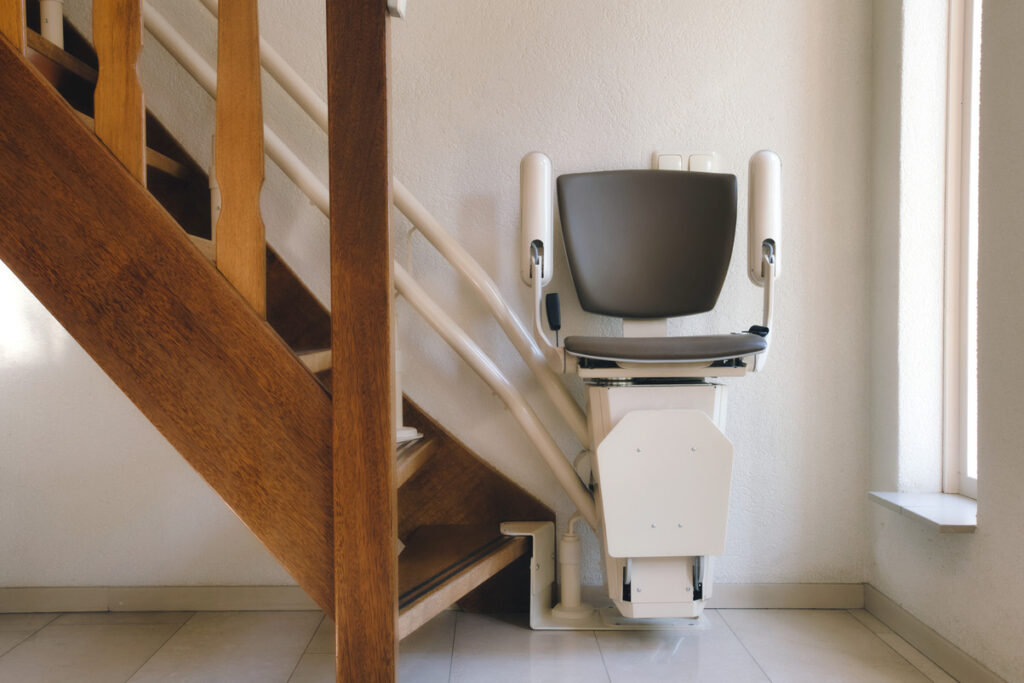
A stairlift may fit when the user can approach the stair, transfer onto the seat, maintain a stable position during travel, and transfer off at the other floor. The rail also has to leave an acceptable stair width and a safe place to park the chair.
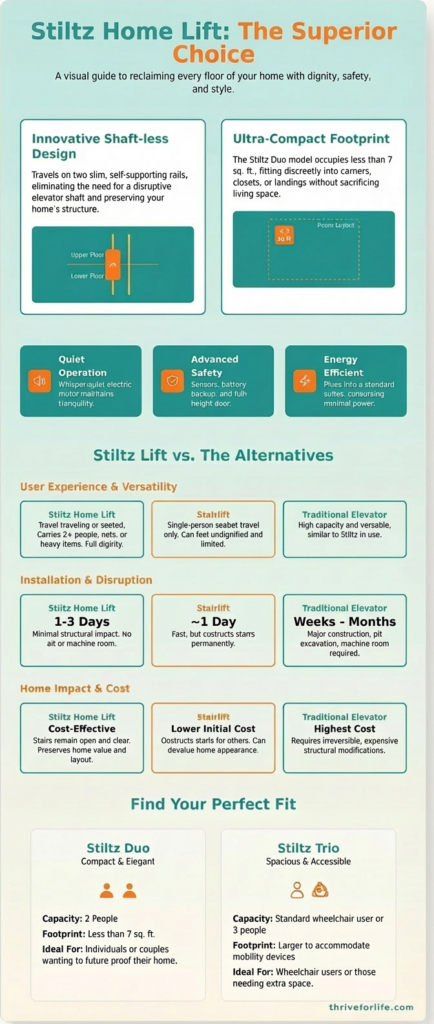
A home lift may fit when the user needs to travel with a mobility device, caregiver, pet, laundry, or household items—or when transfers at the stair are the main barrier. Model capacity, landing space, floor opening, electrical work, and the path on both floors still need to be verified.
Home lift vs. stairlift at a glance
| Decision factor | Stairlift | Compact home lift |
|---|---|---|
| Transfer required | Usually transfer onto and off the seat at each floor | May allow the user to enter with a compatible mobility device |
| Mobility device travels with user | Usually no; a second device may be needed upstairs | Possible with a model and layout designed for it |
| Caregiver can ride | Generally one rider | Possible on some models within capacity and space limits |
| Effect on staircase | Rail and parked chair occupy part of the stair route | Staircase can remain unchanged, but floor space is used elsewhere |
| Construction scope | Rail attachment and electrical preparation; stair geometry must fit | Through-floor opening, landings, electrical, structural and finish coordination |
| Landing needs | Safe transfer and parking space at both ends of the stair | Safe approach, entry, exit, and onward route on both floors |
| Changing mobility needs | Depends on continued ability to complete transfers and ride safely | Depends on model capacity, mobility-device fit, caregiver needs, and the route |
When a stairlift may fit
A stairlift can be a practical option when the person transfers reliably, can remain positioned during travel, and has a safe approach at both landings. Straight and curved stairs require different rails, and doors, narrow hallways, or traffic at the landing can affect the installation.
Consider where the walker or wheelchair will be when the person reaches the other floor. Some households need a second device upstairs. Also confirm how the chair folds or parks and whether other family members can continue using the stairs safely.
When a home lift may fit
A compact home lift can reduce transfer demands and may allow a compatible mobility device to travel with the user. It can also move a caregiver or household items when the chosen model’s capacity and dimensions allow.
Stiltz’s current U.S. brochure lists an approximate 8.5-square-foot footprint for Duo models and approximately 15 square feet for Trio Alta models. These are general reference values, not construction drawings. The exact model, door arrangement, landings, structure, and route still need site verification. Learn more about the Stiltz home lift options available through Thrive for Life.
Questions that reveal the better fit
- Can the user approach and transfer at both ends of the stair on a difficult day?
- Does a wheelchair, walker, oxygen, caregiver, pet, or other item need to travel too?
- Will the stair remain safe and usable for other household members?
- Is there a workable lift location with safe routes on both floors?
- What change in mobility is reasonably likely during the expected life of the project?
- Who provides installation, training, warranty service, and maintenance locally?
Compare the complete project—not a starting price
Ask each proposal to separate equipment, accessories, electrical work, structural or finish work, freight, permits, training, maintenance, warranty, and possible change orders. A low product price may not represent the full installed route.
Do not rely on an unsourced national price range to decide a Hawaiʻi project. Island freight, site access, construction, permitting, and service can change the scope. A site-specific proposal is more useful than a generic online estimate.
Start with an OT-led home accessibility consultation
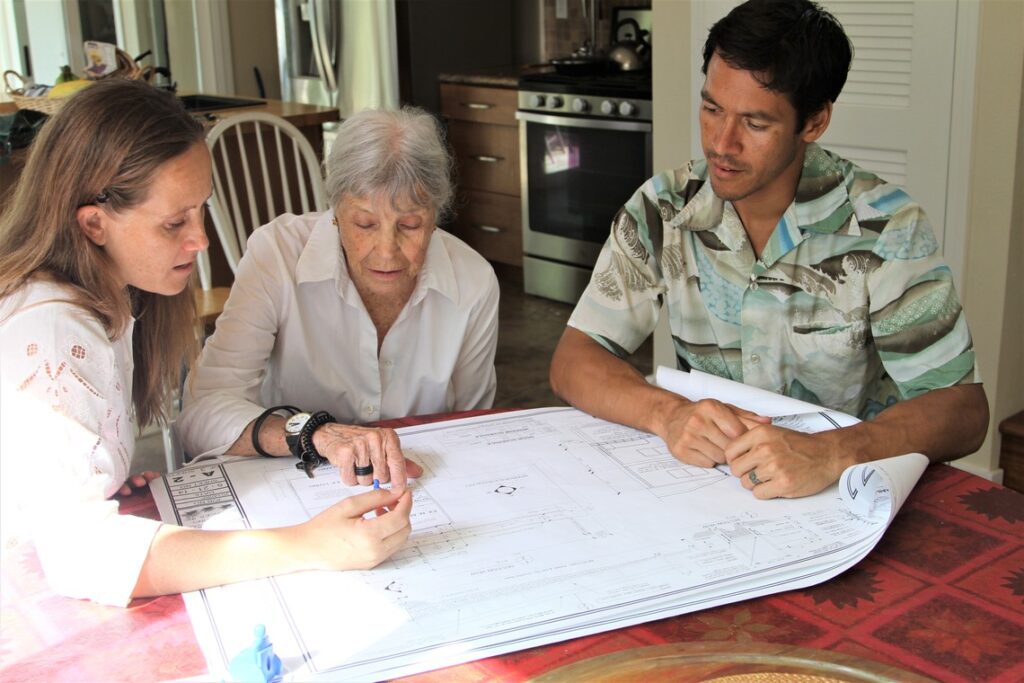
Thrive for Life evaluates the person, transfers, mobility device, caregiver, stairs, landings, floor plan, and likely future needs before recommending equipment. Request a free consultation to compare a stairlift, home lift, reconfigured living plan, or another option for your Hawaiʻi home.

Get a Clear, OT-Led Recommendation to Help You Stay Safe at Home
Before anyone decides about a homelift, we begin with a brief questionnaire to help our licensed occupational therapist understand your home layout, daily movement, and any safety concerns.
Once submitted, our team reviews your answers and contacts you to schedule your free consultation. There is no obligation, no sales pressure, and no commitment. You receive medically informed guidance to understand whether a Stiltz Homelift is the right fit for your ohana.

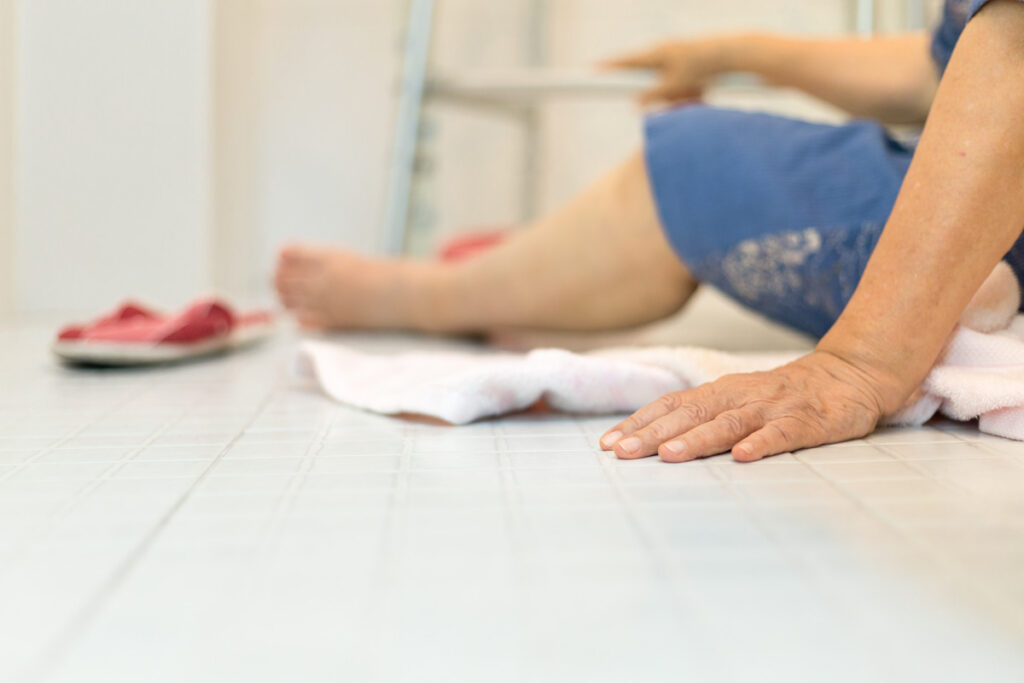
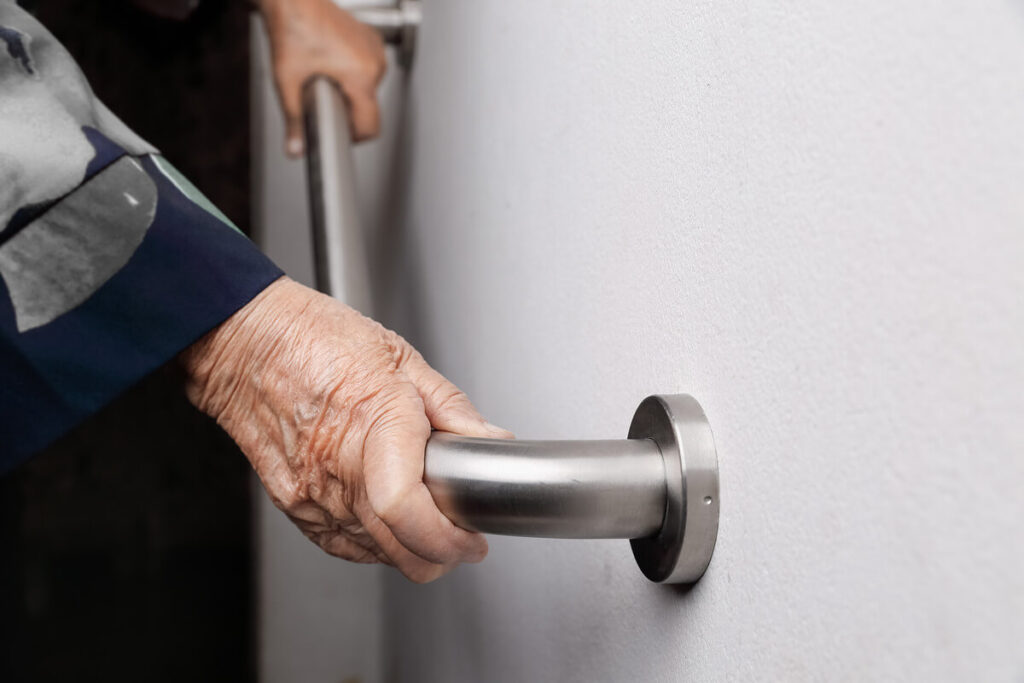
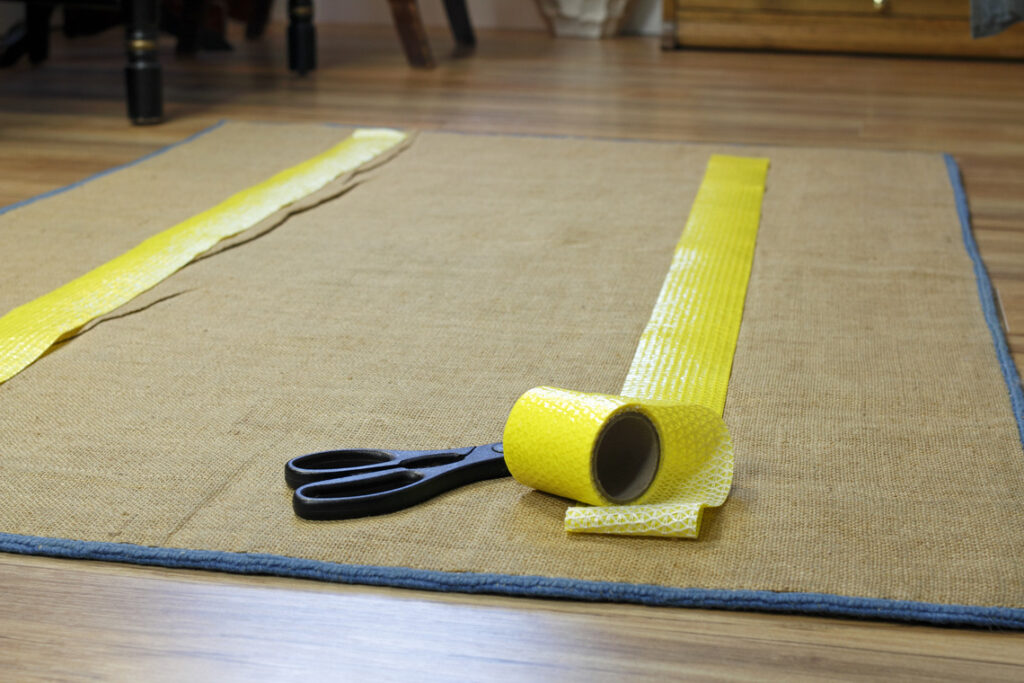
 At Thrive for Life, we understand the importance of fall prevention for seniors who wish to age comfortably in their homes. Falls are a serious concern, with 3 million falls reported annually by the CDC. Of these, 300,000 cases result in hip fractures—a major cause of long-term disability.
Our mission is to provide families with the tools, resources, and personalized care needed to ensure their loved ones remain safe. Each individual has their own unique needs, and we work hard to develop customized solutions for fall prevention.
At Thrive for Life, we understand the importance of fall prevention for seniors who wish to age comfortably in their homes. Falls are a serious concern, with 3 million falls reported annually by the CDC. Of these, 300,000 cases result in hip fractures—a major cause of long-term disability.
Our mission is to provide families with the tools, resources, and personalized care needed to ensure their loved ones remain safe. Each individual has their own unique needs, and we work hard to develop customized solutions for fall prevention.
