

Watch the related videos
Watch Thrive for Life’s Stiltz Home Lift video (39 seconds, published in 2024).
Watch Stiltz Duo Alta Lift (1 minute, 2 seconds, published in 2019).
These archive clips show earlier equipment. Confirm the exact current model, load limits and site needs with your assessment team.
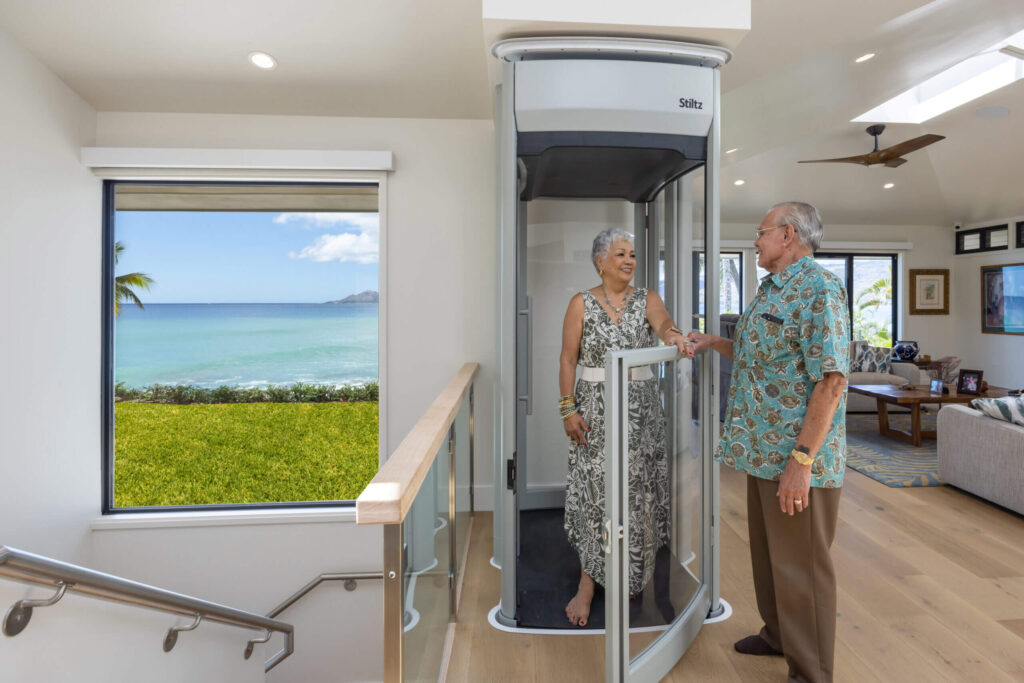
A Stiltz home lift is a compact through-floor lift that moves vertically between levels without a traditional elevator shaft, machine room, or deep pit. For a Hawaiʻi family, that can make it possible to keep using a multilevel home when stairs have become difficult, but the right answer depends on the person, the floor plan, and the home’s construction.
This guide explains how the lift works, what must be evaluated before installation, and how it compares with a stairlift or residential elevator. A site-specific assessment is still essential before choosing a model or location.
How does a Stiltz home lift work?
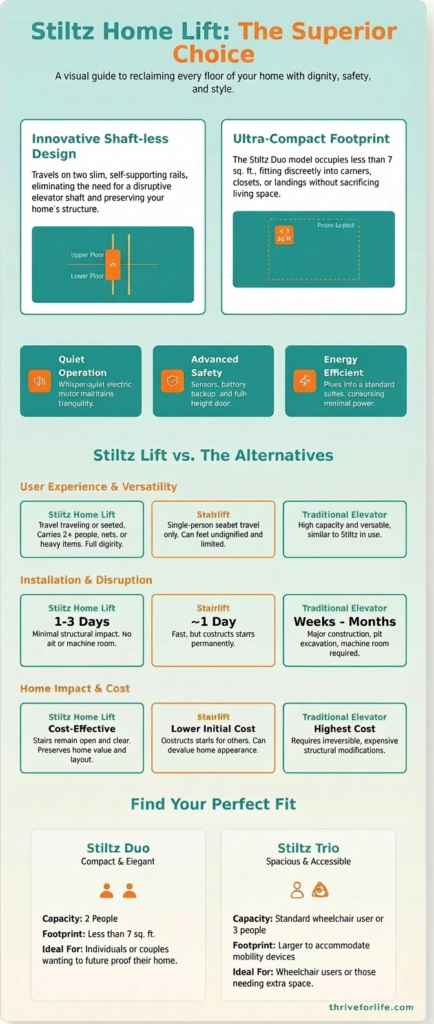
A Stiltz lift travels on two self-supporting rails between two floors. The drive system is located with the lift car, so the design does not require a conventional elevator machine room. Installation normally includes a through-floor opening, electrical work, structural and finish coordination, and safe landing space on both levels.
The product can often fit in locations that would not accommodate a traditional residential elevator, but “compact” does not mean it can be placed anywhere. The route into and out of the lift is as important as the car itself.
How much space does a Stiltz lift need?
Stiltz’s current U.S. brochure lists an approximate 8.5-square-foot footprint for Duo models and approximately 15 square feet for Trio Alta models. The Trio line is intended for users who need more interior space, including many wheelchair applications. Published dimensions are general reference values rather than construction drawings, so final clearances and site requirements must be confirmed for the exact model and home.
Review the official Stiltz Duo and Trio Alta brochure, then have the proposed location measured and evaluated before treating a floor-plan concept as final.
What has to be checked in a Hawaiʻi home?
A home lift is not chosen from a product photo alone. A useful site assessment checks:
- how the person moves now and how those needs may change;
- whether a walker, wheelchair, caregiver, pet, or household items need to travel with the user;
- the landing location on both floors and the path into and out of the lift;
- floor framing, ceiling height, electrical requirements, and the work needed to form the through-floor opening;
- how the installation affects bedrooms, living areas, closets, and emergency movement through the home; and
- local permitting, contractor, and inspection requirements for the actual scope.
The goal is not simply to find a place where a lift can fit. It is to find a route that works for the person and still makes sense for the household.
Stiltz home lift vs. stairlift
A stairlift may fit when the user can approach the stair, transfer onto the seat, maintain a stable position during travel, and transfer off at the other floor. The rail also needs to preserve an acceptable staircase route for everyone else.
A Stiltz home lift may fit when the user needs to travel with a mobility device, caregiver, laundry, or other household items, or when transfers at the stair are the main barrier. Model capacity, landing space, construction, and the route on both floors still need verification.
Neither solution is automatically right because of age or diagnosis. The decision should reflect current function, likely changes, caregiver capacity, home layout, project scope, and budget.
Stiltz home lift vs. a traditional residential elevator
A conventional residential elevator generally uses a shaft or hoistway and may offer different car sizes, door configurations, travel distances, and finish options. A through-floor lift can have a smaller construction footprint, but product limits and the through-floor opening create a different planning problem.
Compare the complete installed route, not just the equipment. Ask what structural, electrical, finish, permit, freight, warranty, training, and service work is included.
Three questions to answer before choosing a Stiltz lift
- Can the user transfer safely at both floors? If transferring to a stairlift chair is unreliable, a wheelchair-capable home lift may better support the long-term plan.
- What needs to travel with the person? A caregiver, mobility device, laundry, pet, or medical equipment can change the required model and landing space.
- Will the proposed location still work if mobility changes? A solution that works today but creates a difficult route later may be the wrong investment.
What should a complete proposal include?
- The exact lift model, capacity, door configuration, and included options
- Structural opening, reinforcement, electrical work, and finish repair
- Landings and accessible routes on both floors
- Permit and inspection responsibility
- Freight, installation, user training, warranty, and local service
- Assumptions that could become change orders
Start with the person and the complete route
Thrive for Life combines an OT-led functional assessment with practical home-modification planning. We evaluate the person, mobility device, caregiver, floor plan, transfers, and likely future needs before recommending a product. Request a complimentary assessment to determine whether a Stiltz lift, stairlift, reconfigured living space, or another solution best fits your Hawaiʻi home.

Call us: +1.808.289.7816

Get a Clear, OT-Led Recommendation to Help You Stay Safe at Home
Before anyone decides about a homelift, we begin with a brief questionnaire to help our licensed occupational therapist understand your home layout, daily movement, and any safety concerns.
Once submitted, our team reviews your answers and contacts you to schedule your free OT assessment. There is no obligation, no sales pressure, and no commitment. You receive medically informed guidance to understand whether a Stiltz Homelift is the right fit for your ohana.